

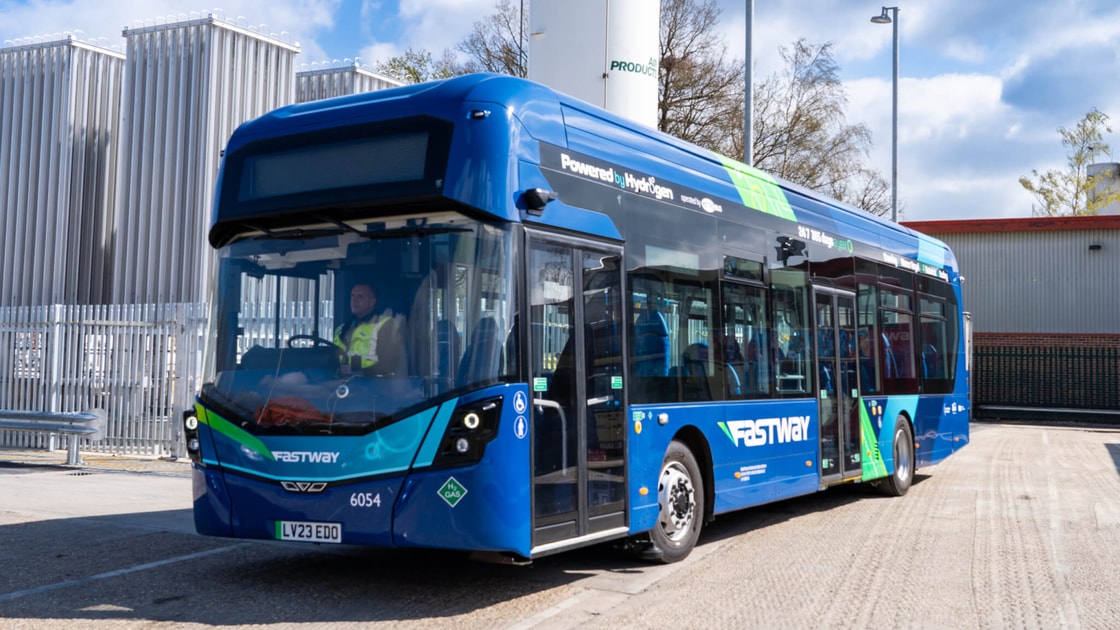
Emergency services responded to a hydrogen bus fire in the south of the UK on Tuesday (2 December).
West Sussex Fire and Rescue Service said it was attending to an “incident” near a shopping centre in Crawley at around 12:30pm.
Images and videos posted on social media show the roof of a blue single-decker bus on fire at the side of the road. Typically, both the hydrogen storage tanks and fuel cells are installed on the roof of buses.
A spokesperson for the fire service said three fire engines and an aerial ladder responded to the fire.
Local transport firm Metrobus confirmed to H2 View one of its hydrogen buses supplied by Wrightbus was destroyed by the fire, with early indicators suggesting an electrical fault possibly caused the incident.
The company also confirmed no one was injured during the event, and a full investigation has been launched into the cause.
“We can confirm that no one was injured. The driver acted with exceptional professionalism, ensuring all passengers were safely evacuated,” Ed Wills, Metrobus Managing Director, said in a statement to H2 View.
“We have had no such previous incidents with hydrogen buses, and have launched a full investigation into the cause of the fire alongside our partners at Wrightbus.”
H2 View has also contacted Wrightbus for comment on the incident.
Go-Ahead Group, which owns Metrobus, began operating a fleet of 20 hydrogen fuel cell buses supplied by Wrightbus in 2022, with liquid hydrogen being supplied by Air Products.
These buses were set to operate on routes serving Crawley, Gatwick Airport, and Horley.
Go-Ahead had signed another deal for zero-emission buses from Wrightbus, which was expected to include some hydrogen vehicles.
Earlier this year, seven hydrogen fuel cell buses at a depot in France were destroyed by a fire linked to an electrical cause.
This latest incident further underscores the need for rigorous safety protocols in all hydrogen applications – especially as it moves beyond its traditional industrial setting.
Preparing hydrogen for safe public applications
As hydrogen’s use expands beyond its traditional chemical and industrial applications, safety procedures must adapt to accommodate users without specialist expertise.
The molecule has long been central to various processes and industries and will remain so. The need to mitigate climate change is making hydrogen relevant for domestic, commercial, and consumer applications where it has not been used before.
Safety is of paramount importance in all hydrogen applications. Nobody should get hurt, and assets must be protected through the energy transition. Safety equipment, procedures and smart controls already exist. When these are properly applied by people with appropriate training, each economically viable hydrogen application can be implemented without concern.
Click here to keep reading.