

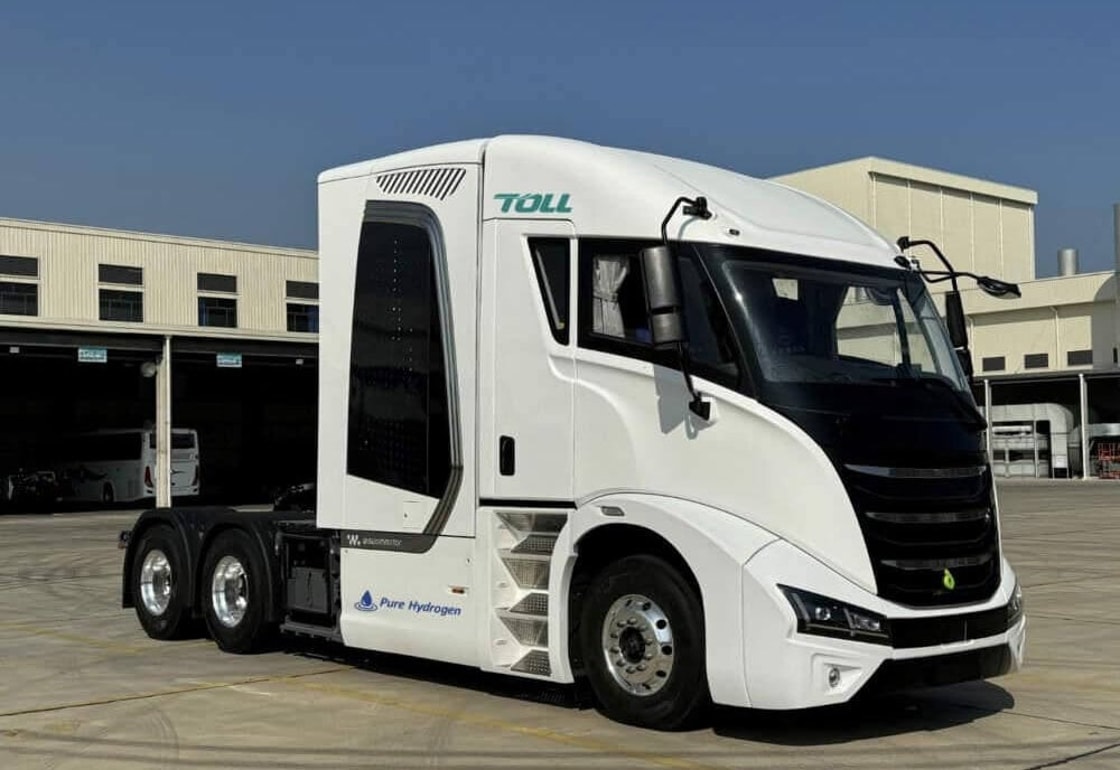
The company confirmed it has entered into a sales agreement with New South Wales-based transport company, Scott Lovatt Transport, for the delivery of two TS70-400 Taurus prime mover trucks for over AUD $2m ($1.3m).
However, the sale isn’t final yet, and the deal will only go ahead if government funding can be secured for the project. The parties are “confident” they can obtain access to the relevant funding once the application has been submitted.
Additionally, Pure Hydrogen secured a follow-up purchase order from Heidelberg Materials Australia for the supply of a second hydrogen fuel cell 8×4 agitator rigid truck.
Featuring a 200kW fuel cell system, the concrete mixer will be paired with a previous unit ordered by Heidelberg and used in joint operation in Rockingham, Western Australia.
This unit is expected to be delivered in early 2026, while the prime movers are scheduled to be delivered by mid-2026.
Pure Hydrogen Managing Director Scott Brown said the government-pending deal with Scott Lovatt Transport Group demonstrates that, after years of trials and regulatory approvals for the prime mover, the company has now proven market demand for its vehicles.
“The addition of the second Heidelberg Materials concrete agitator truck highlights the strong commercial potential of our technology and the growing demand for sustainable heavy vehicles in the industry,” Brown added.
Decarbonising heavy-duty transport: Why hydrogen must stay in the race
There is no doubt that we have seen setbacks in the hydrogen mobility sector in recent years. While this ‘age of realism’ has still seen a seven-fold increase in committed capital for hydrogen projects reaching final investment decision (FID) in the past four years1, sceptics question the role of hydrogen outside sectors where no viable alternatives currently exist, such as in the production of ammonia or sustainable aviation fuel (SAF).
This is particularly evident in Germany: once making strong steps towards being Europe’s leading adopter of hydrogen mobility, with a willingness to build out the minimum viable network for light-duty hydrogen vehicles, strong policy incentives, and generous funding for heavy-duty hydrogen vehicles and HRS, the cancellation of funding and crash of greenhouse gas (GHG) quota prices over the past year have made the business case for hydrogen mobility increasingly challenging and risky. Inevitably, this has led to a loss in momentum which the sector (and indeed, the planet) does not have time for.
Now is a crucial time to reexamine the need for hydrogen in decarbonising our heavy-duty transport systems, and what we need to do now to enable its implementation.
H2 View subscribers can continue reading here.