

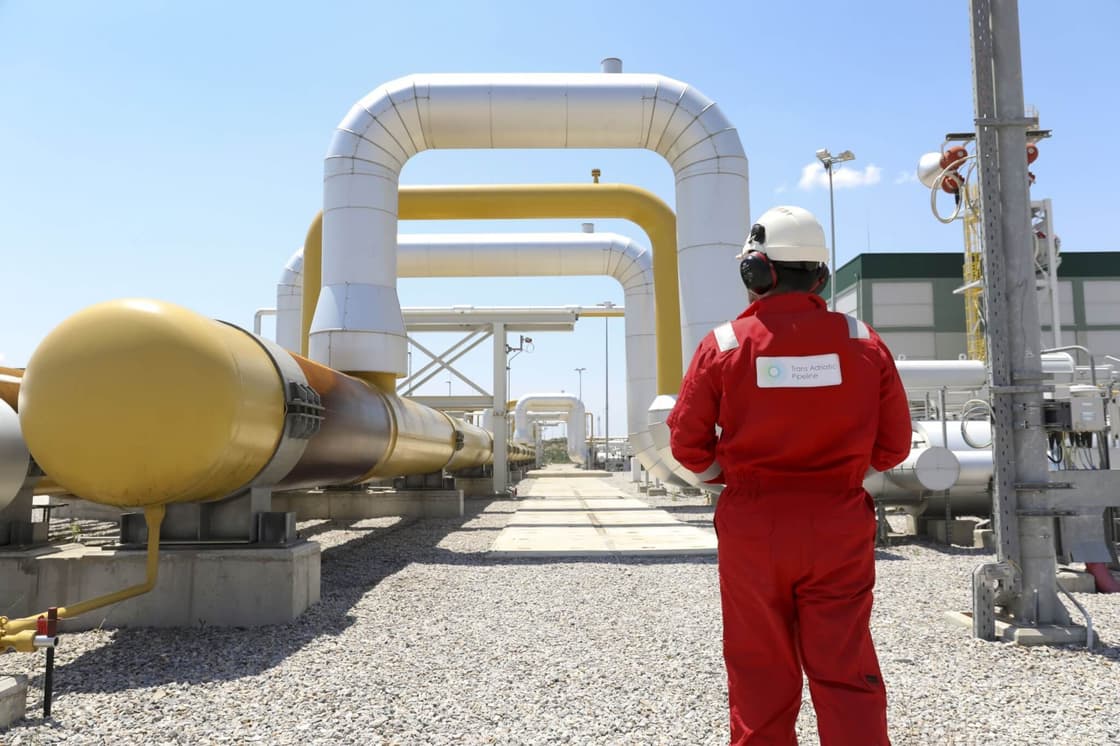
The 877km Trans Adriatic Pipeline (TAP), connecting the Trans Anatolian Pipeline (TANAP) at the Greek-Turkish border to Italy’s gas network, is exploring hydrogen integration to support capacity expansion, sustainability, and regional decarbonisation.
The TAP transmission system operators (TSOs) have not disclosed the targeted hydrogen blending ratio, but the consortium initiated an Initial Hydrogen Readiness study in 2021.
TAP’s Managing Director, Luca Schieppati, claimed that the network has the “potential to become a significant contributor to Europe’s goal of achieving carbon neutrality,” which would include the supply of hydrogen blended with natural gas.
“Evaluating whether our above-ground installations are hydrogen-ready for hydrogen blending with natural gas, with the support of an experienced supplier like Penspen, is an important step in this broader process,” Schieppati added.
Penspen, the UK-based engineering team, will provide a “comprehensive desktop and field assessment review” of TAP’s above-ground installations (AGIs), block valves (BVs) and compressor stations (CSs) to assess the feasibility of hydrogen blending.
“By assessing the suitability of existing infrastructure, like the TAP pipeline, for hydrogen blends, we continue to support the delivery of cleaner energy to the communities we work in,” explained Darren Bartlett, Energy Transition Director at Penspen.
Angus Reid, Project Manager for the TAP project at Penspen reiterated that hydrogen enablement of strategic transportation infrastructure is “a key factor for long-term regional decarbonisation.”
Reid continued, “Supporting the introduction of hydrogen into a major pipeline will promote hydrogen generation projects in southeastern Europe, as well as a multitude of hydrogen use opportunities.”
The contract with TAP builds on Penspen’s recent agreement with Latvian gas operator Conexus Baltic Grid to explore hydrogen blend feasibility for its natural gas network. Additionally, they have supported a Portuguese TSO by providing hydrogen readiness assessments down to the component level for up to 100% hydrogen blends.
Read more: Penspen awarded contract to explore hydrogen blending in Latvian gas grid
In the UK, Penspen worked with EET hydrogen on the front-end engineering design (FEED), consenting, land, environment and stakeholder engagement services for the HPP1 low-carbon hydrogen plant at Ellesmere Port, Cheshire.
Read more: EET Hydrogen’s plans to develop a hydrogen production facility in Cheshire approved
Hydrogen blending: A balance of benefits
While the direct use of hydrogen in many of the applications discussed in this ‘Grid Balancing and Energy Security’ issue is often seen as the end goal, there has been growing excitement over the prospect of blending hydrogen with natural gas as an interim step to lower emissions in the shorter term.
In theory, blending the two gases will lower the emissions from natural gas grids while allowing existing infrastructure to be used, serving end-users where electrification is uneconomic.
From boilers and gas turbines to industrial processes and more, the idea of blending has been bounced around in a variety of geographies, with many policy-led projects exploring the pathway’s potential.
Continue reading here.