

Mario Draghi’s report on the future of European competitiveness laid out clear recommendations on how Europe can boost its economic growth.
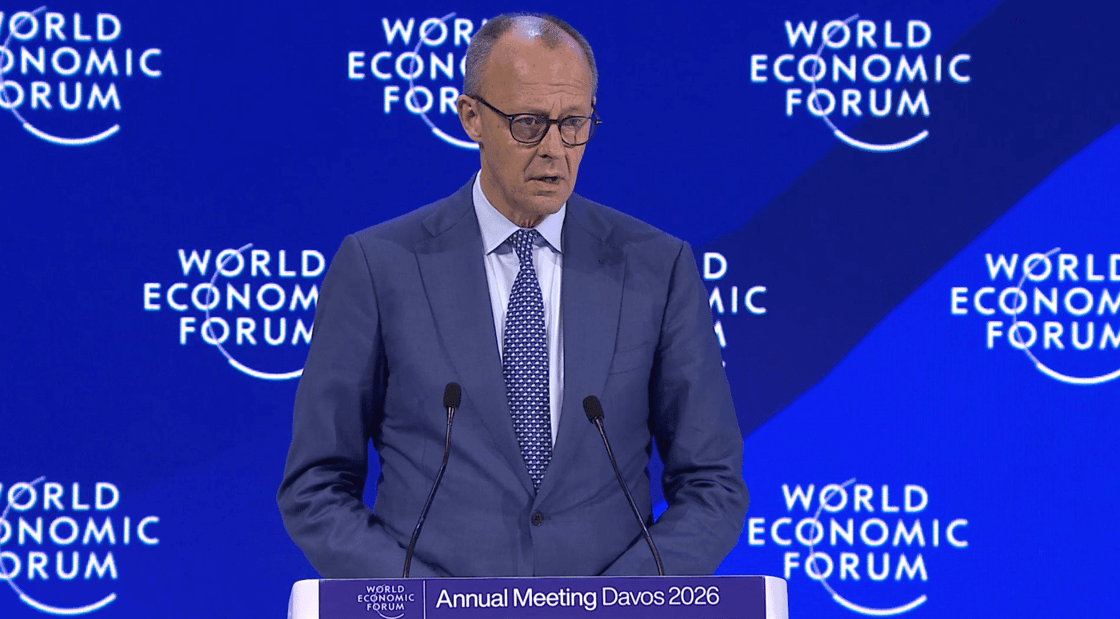
But speaking at Davos, Merz said only around 10% of its proposals have been put in place.
“We have to do much more than that,” he said. “The entire energy system has to be reformed. We have new gas power plants in place, so this is work in progress. We are faced with one big obstacle, and that’s productivity. Within that the obstacles are cost, bureaucratic burdens, taxes and labour costs.”
Merz said Germany will convene an extraordinary meeting of the European Council in Belgium on 12 February. Alongside the Draghi report, the Chancellor said discussions would focus on another report concerning the completion of the internal market.
His comments were referenced in a presentation which focused heavily on the geopolitical situation, after the US and Europe hatched a framework on Greenland and Arctic security on Wednesday, leading to President Trump to halt planned tariffs on eight European countries in February.
“Our power today rests on three pillars – our security, our competitiveness and our unity,” he said. “Although it’s frustrating over the past few months to see the development of the Transatlantic partnership, we have to uphold it.”
Clean hydrogen has increasingly been positioned as an answer to Europe’s competitiveness crisis, which has seen production in key sectors dwindle in recent decades. However, increasing potential hydrogen users in steel and fertilisers have warned that the cost of transitioning could further erode their ability to compete.
Germany’s electricity prices are among the highest in Europe due to transmission fees, taxes, and levies that fund the energy transition.
Nonetheless, Germany is pressing ahead on hydrogen. In December, Berlin approved its GHG-Quota, which would force fuel suppliers to reduce emissions by almost 60% in 2040, while implementing key parts of the EU’s Renewable Energy Directive III.
From 2026, RFNBOs (including green hydrogen) will need to make up 0.1% of transport energy, growing to 1.2% in 2030, and 8% by 2040.
US PEM firm Electric Hydrogen estimates the 2030 quota alone could require 1.1GW to 4.2GW of electrolyser installations.
Under its freshly agreed power plant strategy, Germany also plans to build 12GW of new gas-fired power generation, which would need to switch to running on hydrogen by 2045. Tenders are expected to be launched this year.