

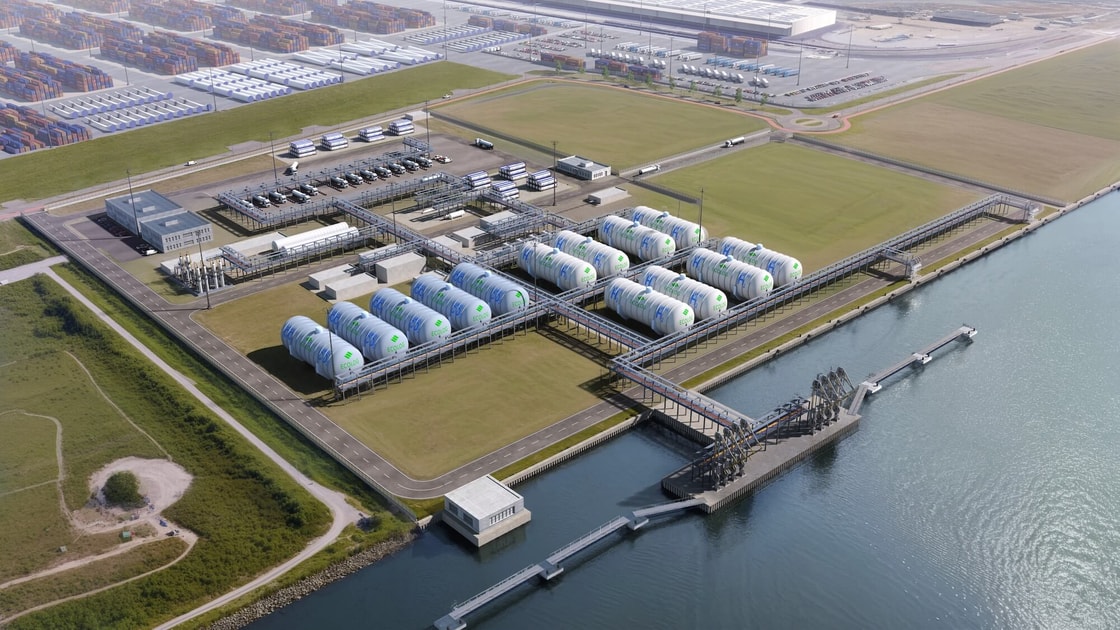
The port infrastructure is being headed by CO2 shipper EcoLog, which has plans to explore importing LH2 from low-cost production regions like the Nordics and the Middle East.
If built, the terminal could handle up to 200,000 tonnes of LH2 imports and 1.8 million tonnes of LCO2 exports per year. EcoLog also intends to reserve the option to expand the facility to 600,000 and 4.25 million tonnes, respectively.
Under the FEED contract, which is expected to be concluded this year, KBR will define the engineering basis, storage systems, operational parameters and safety standards for the terminal.
LH2 would be transported to the terminal by a fleet of new vessels currently being developed by EcoLog, while CO2 would be brought to the terminal by pipelines, trucks and barges.
A timeline for the terminal’s start-up has not been revealed.
EcoLog is part of a joint development agreement looking to import LH2 from Oman’s Port of Duqm, where state-backed green hydrogen projects are being developed, to the Port of Amsterdam for use in the Netherlands and Germany.
It also intends to ship LH2 from Norwegian producer Gen2 Energy to Amsterdam for use by Tata Steel.
“The realisation of the EcoLog Terminal Amsterdam holds large promise for Europe’s decarbonisation ambitions,” said Ellen Ruhotas, CEO of EcoLog.
While clean hydrogen imports are a key part of the EU’s strategy, long-distance trade of the molecule remains fraught with difficulties.
Just this week, the Port of Rotterdam said market consultation with companies looking to set up hydrogen import infrastructure revealed most would not begin operations by 2030, citing demand uncertainty, permitting, and grid congestion as barriers.
Additionally, liquid hydrogen faces technical challenges. Critics say transporting liquid hydrogen over long distances is technically and economically challenging, due to the extremely low temperatures (–253ºC) the molecule must be kept at, and potential boil-off.
Supporters argue that liquid hydrogen offers efficiency advantages over carriers like ammonia, which require an energy-intensive cracking process to release pure hydrogen.
Never miss a hydrogen headline
Hydrogen moves fast – stay on top of it with our daily and weekly briefings.
- Daily: The top five hydrogen stories, straight to your inbox
- Weekly: The week’s biggest news, features, interviews and analysis
- North American Bulletin: Dedicated coverage of the region’s key hydrogen developments