

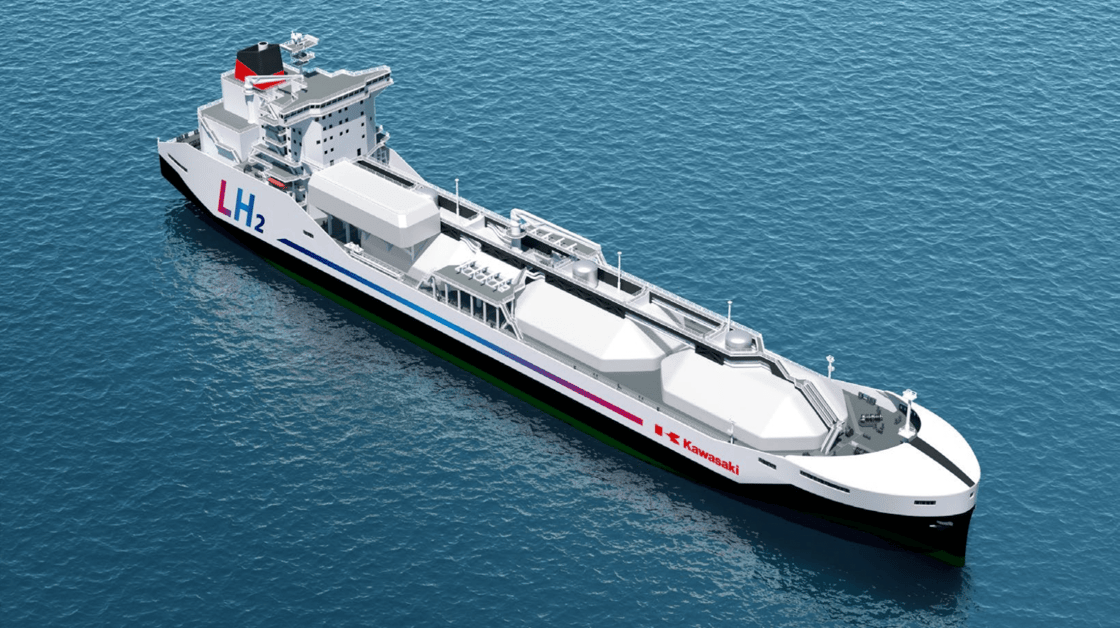
The vessel will be built at Kawasaki’s Sakaide Works in Kagawa Prefecture and is anticipated to begin operating in the early 2030s, aligning with Japan’s plans to scale up imported hydrogen supply.
Designed by KHI, the vessel will be based on the Suiso Frontier, which completed the world’s first liquid hydrogen export from Australia to Japan in 2022, but at a scale more than 30 times smaller.
KHI said the vessel will use an insulation system to reduce boil-off, which occurs when liquid hydrogen warms above -253ºC and reverts to gas.
Additionally, it will be equipped with an electric propulsion system featuring a “hydrogen/oil-based dual-fuel generator engine” to support a conventional oil engine.
The new ship will be used to supply the Kawasaki LH2 Terminal in Ogishima, which will be equipped with a 50,000m3 liquid hydrogen storage tank, along with maritime cargo handling, liquefaction and lorry dispatch facilities.
KHI and JSE broke ground on the site last November.
It comes as Japan accelerates efforts to secure large-scale, low-cost imported hydrogen from overseas producers. In September, Woodside Energy signed an agreement to explore exporting volumes of blue hydrogen from its planned project in Perth, Australia, to Japan with JSE and the Kansai Electric Power Co.
KHI said the new vessel would provide a “stable supply” of large volumes of hydrogen to support the decarbonisation of Japanese industry.
The strategy is to transport hydrogen like liquefied natural gas, opening routes to decarbonise energy-importing countries like Japan.
However, critics say transporting liquid hydrogen over long distances is technically complex and costly, due to the extremely low temperatures (–253ºC) the molecule must be kept at, and potential boil-off.
Supporters argue liquid hydrogen offers efficiency advantages over carriers like ammonia, which require an energy-intensive cracking process to release pure hydrogen.