

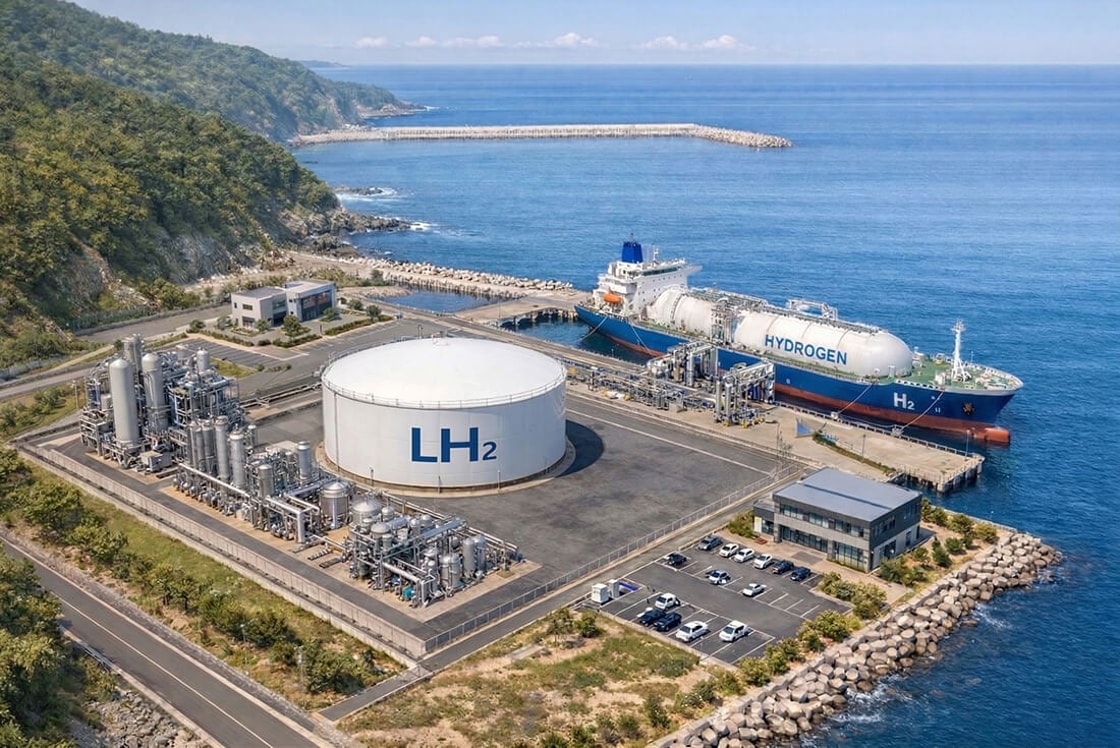
Under the 45-month project ending December 2029, the South Korean conglomerate will design, construct, and demonstrate large-capacity storage tanks to support future LH2 imports.
Beginning with demonstration tanks of 200m3, South Korea’s Ministry of Land, Infrastructure and Transport (MOLIT) hopes the project could support upscaling to tanks up to 50,000m3 in capacity.
The flat-bottomed, cylindrical, large-capacity storage systems will support storage, transfer, and unloading.
According to Hyundai E&C, the project could help MOLIT design standards focused on safety and reducing LH2 boil-off gas. The government intends to use findings to inform the construction of liquid hydrogen terminals and the scale-up and commercialisation of storage facilities.
South Korea is increasingly looking to import clean hydrogen to support its plans to decarbonise its power and mobility sectors.
In a statement, Hyundai E&C said that liquid hydrogen technology is “still in its infancy,” adding that the project could strengthen Korea’s competitiveness in the sector.
While proponents say that liquid hydrogen offers efficiency advantages over carriers like ammonia, the need for cryogenic transportation systems renders its logistics complex and costly.
Advanced insulation is required to prevent temperatures of above 253°C, which result in losses due to boil-off gas.
Never miss a hydrogen headline
Hydrogen moves fast – stay on top of it with our daily and weekly briefings.
- Daily: The top five hydrogen stories, straight to your inbox
- Weekly: The week’s biggest news, features, interviews and analysis
- North American Bulletin: Dedicated coverage of the region’s key hydrogen developments