

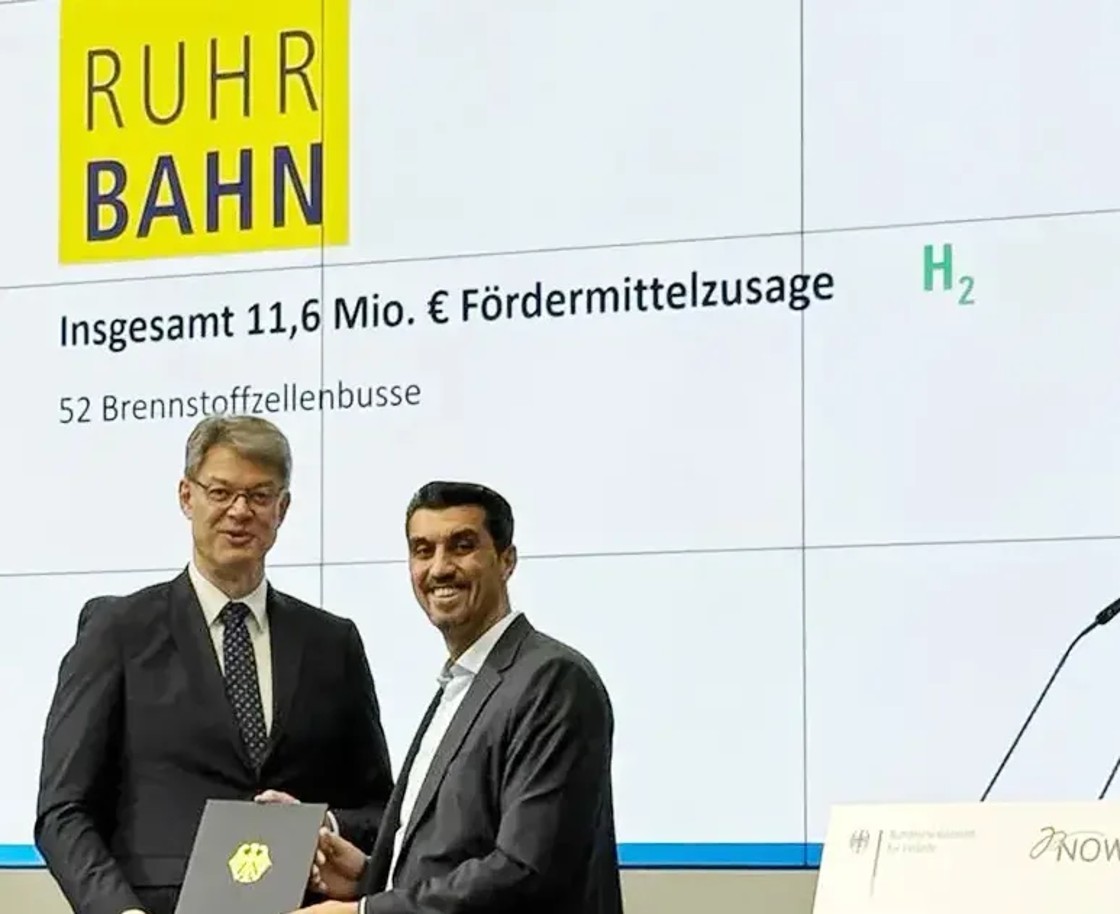
The funding from Germany’s Federal Ministry of Transport looks to accelerate the gradual replacement of diesel buses in the Ruhr region.
The new buses will add to an existing fleet of 19, which have operated in the area since 2025, to bring the total hydrogen-powered fleet to 78 by 2027/2028.
Seven new vehicles are expected to enter service this year.
Federal Transport Minister Patrick Schnieder praised the range, refuelling times, and operational flexibility of the hydrogen buses.
“We are supporting transport companies in modernising their fleets step by step – for clean mobility, economic strength, and reliable services for local residents”, he continued.
This comes as public transport operators in Europe increasingly eye hydrogen-powered buses to decarbonise their fleets, and EU directives mandate green hydrogen to be used for 1.2% of transport energy by 2030.
Germany’s hydrogen refuelling infrastructure also continues to expand, with companies including Lifte H2, H2 Mobility, and MB Energy rolling out refuelling stations.
The country’s transport ministry has also recently invested €54m ($64m) in a new hydrogen mobility research hub in Bavaria, and launched a €220m ($260m) call for proposals to establish a trial network of up to 40 hydrogen refuelling stations.
Despite the increased range and low refuelling times, hydrogen vehicles are criticised for their low energy efficiency compared to battery electric vehicles. This criticism came to the forefront of a recent H2 View webinar exploring the most viable applications for hydrogen in road transport.
Hydrogen trucking: Is efficiency the only metric?
Questions around efficiency have been among the biggest challenges raised against hydrogen mobility.
Using electricity to produce hydrogen, which needs compressing, transporting, and dispensing before conversion into electricity or being combusted, provides inherent losses compared to direct electrification – all of which add to costs.
But is it the only consideration for vehicle operators looking to decarbonise? H2 View’s latest webinar homed in on this debate, hearing both sides of the argument.
Click here to keep reading.