

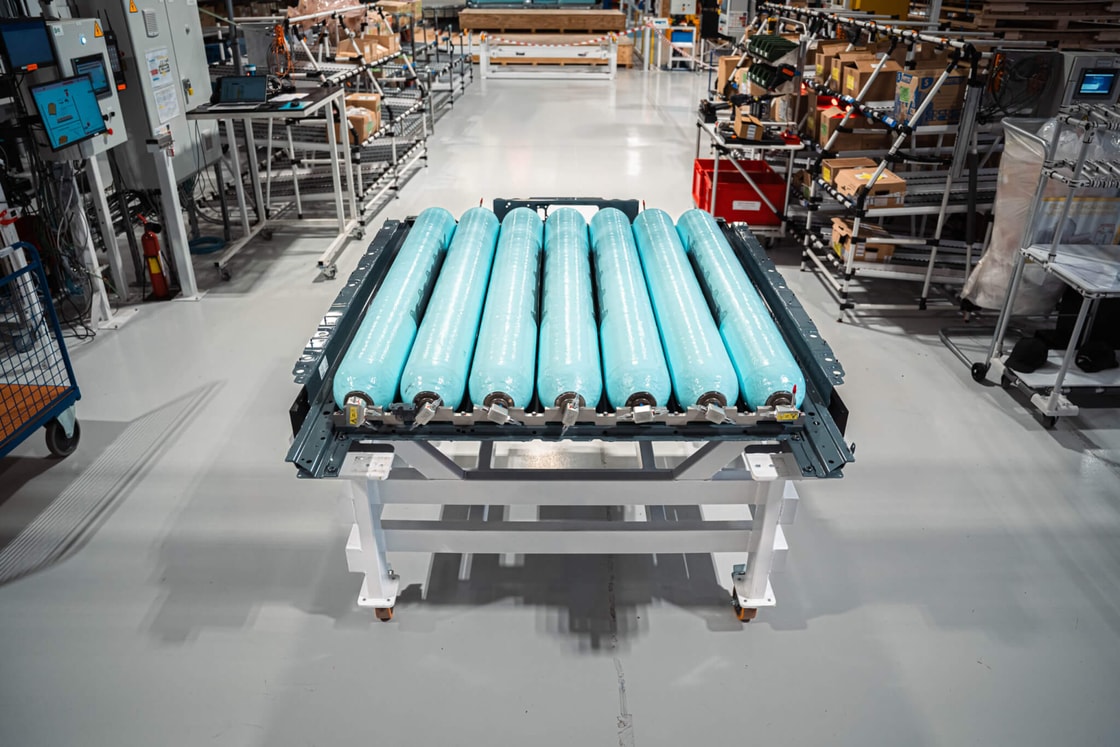
The new configuration – consisting of seven connected 500bar carbon-fibre hydrogen tanks – makes for a flat fuel storage system that, unlike in older fuel cell electric vehicle (FCEV) models, does not intrude into the rear cargo area and cut storage space.
Capable of holding 7kg of gaseous hydrogen, BMW said the arrangement will improve the vehicle’s range up to 750km from approximately 500km.
It is slated to simultaneously bolster BMW’s capacity for constructing the vehicles, enabling their construction on the same production line as other drive types.
Dr Joachim Post, Member of the Board of Management of BMW AG, said the new engineering will allow customers to choose more freely between drive systems in the iX5.
BMW has been developing the iX5 Hydrogen model for over four years and intends to launch series production of the FCEV in 2028 under a collaboration with Toyota.
The car maker has been granted a combined €273m ($318.8m) in funding for advancing the powertrain and tank system for the model through Germany’s Federal Ministry of Transport and the State of Bavaria.
Despite major backing from certain carmakers, the uptake of passenger FCEVs has been extremely limited and geographically focused in regions like South Korea and California.
Aside from critiques about the low efficiency of using hydrogen as a fuel, early FCEV users have faced major challenges with the availability and reliability of refuelling infrastructure.
Increasingly, the wider sector is backing hydrogen for heavy-duty use cases, while battery electric is increasingly the frontrunner for passenger vehicles.
Never miss a hydrogen headline
Hydrogen moves fast – stay on top of it with our daily and weekly briefings.
- Daily: The top five hydrogen stories, straight to your inbox
- Weekly: The week’s biggest news, features, interviews and analysis
- North American Bulletin: Dedicated coverage of the region’s key hydrogen developments