
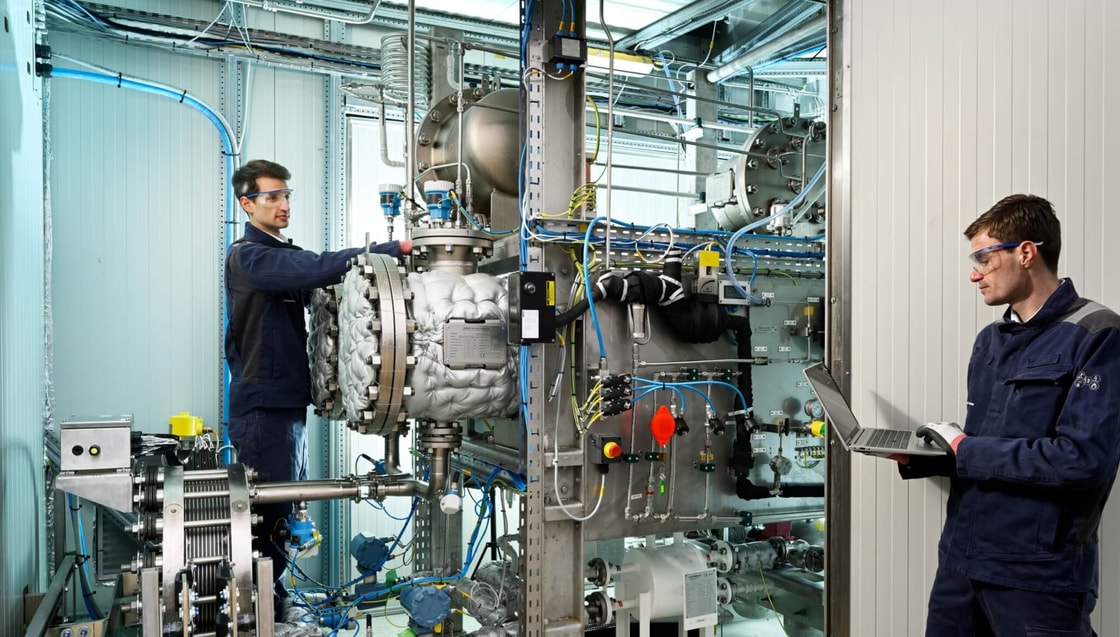
First announced in July 2025, the merger has combined all activities and over 50 employees as the new business looks to commercialise an electrolyser system with internal electricity storage capacity.
Financial details of the merger have not been revealed.
VDL Hydrogen’s parent company, industrial manufacturing firm VDL Groep, will assemble the stacks on behalf of Alquion.
Former Battolyser boss Mattijs Slee has taken the CEO role at the new company.
Alquion expects to make an investment decision for a 0.5MW demonstration unit at an unnamed “industrial customer site” this May. It intends to build systems 10MW to 15MW in size, but has not confirmed a go-to-market timeline.
Unlike existing alkaline systems for industrial applications, Alquion claims its Flexolyser technology can be switched on and off to adjust to fluctuating renewable energy sources “safely and without loss of performance.”
No comparative cost data with other electrolyser technologies has been disclosed.
This is a combination of Battolyser and VDL’s individually developed systems. Battolyser had created a system based around an atmospheric alkaline platform using nickel-nickel electrodes, which can store electricity.
VDL, on the other hand, had been focused on developing a pressurised alkaline system.
Pressurised alkaline electrolysers produce hydrogen at over 30 bar, which reduces downstream compression requirements, while also offering faster ramp-up rates.
The pitch primarily focuses on producing green hydrogen for injection into pipeline networks to support electricity grid management.
“When wind conditions are strong, a Flexolyser can convert excess electricity into hydrogen and inject it into the pipeline network,” a press statement said. “When wind conditions are low, a Flexolyser can be switched off, supplying customers with stored or imported hydrogen.”
In this model of operation, Alquion claims its platform can reduce green hydrogen production costs by “up to 25%.”
VDL Groep President and CEO, Willem van der Leegte, said the new business would allow the Netherlands to “optimally” use its offshore wind potential.
Hourly matching, additionality, and the case for flexible electrolysis
Electrolyser capital costs, renewable electricity prices, and system efficiency are the three main contributors to the levelised cost of green hydrogen (LCOH). But which is the most important will depend on individual projects.
Intentionally intermittent electrolyser operation during periods of low, zero, and negatively priced renewable power is the only viable way to produce green hydrogen for less than €5 ($5.83) per kilogram in most European countries. Executing such a strategy means understanding regulations and complementary hydrogen infrastructure.
Over the next 10 years, intentionally intermittent operation is likely to be the main, or perhaps the only, way that green hydrogen will be produced with unsubsidised business cases in most of Europe…
Click here to keep reading.