

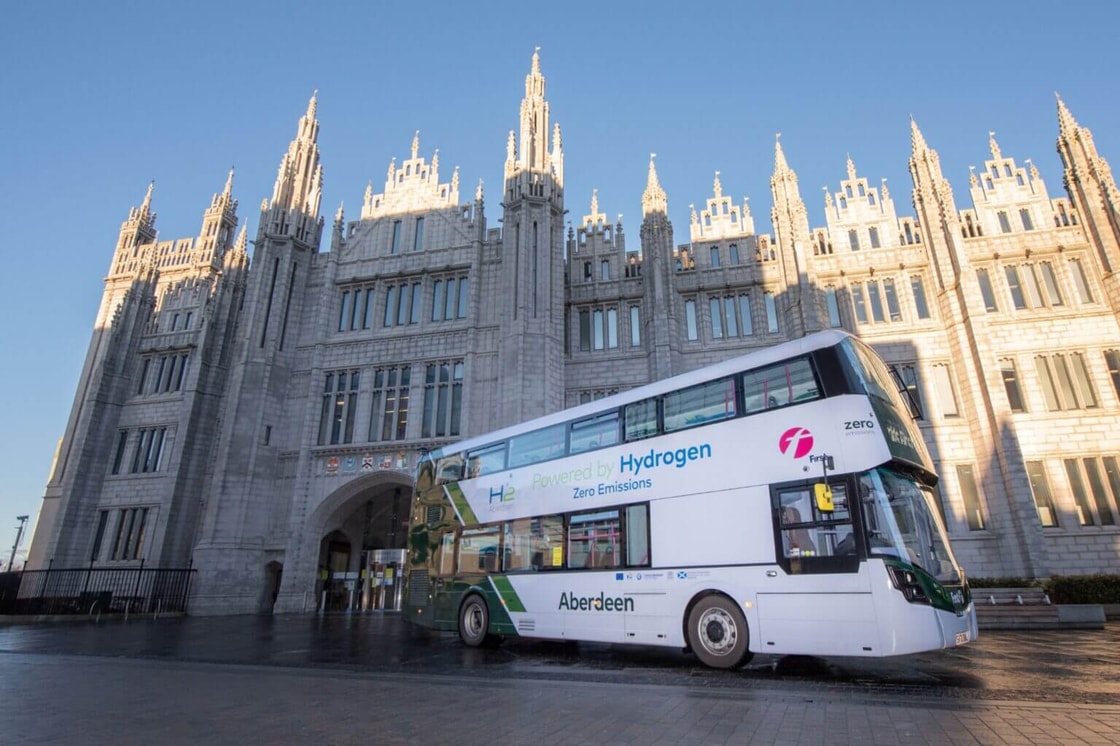
Aberdeen City Council said it would drop the 25-double-decker bus fleet in favour of electric vehicles, after a series of technical problems.
Operated by First Bus, the fleet of Wrightbus Hydroliner FCEVs has been on Aberdeen streets since 2021 under a local and EU-funded £8.3m ($11.2m) project. It was billed as the “world’s first” hydrogen double-decker fleet.
The buses have been out of operation since the winter of 2024 due to delays in repairing and refuelling equipment across the city, leaving the buses parked up at First’s depot.
In a statement, the council said the decision to axe the fleet was driven by “significant advancements in electric vehicle (EV) technology.”
“As manufacturers increasingly favour EVs, demand for hydrogen in transport has diminished,” a spokesperson added.
It has not disclosed a timeline for the fleet’s sale.
The Council launched a JV with BP in 2022 to develop local green hydrogen production, storage, and refuelling capacity for the fleet. But these plans too look to be scrapped.
It has now said it will negotiate taking full control of the JV to ensure the city’s assets are “optimised to facilitate the city’s shift towards low-carbon EV transport.”
The move underscores challenges in hydrogen mobility. With EV technology evolving rapidly, criticisms have become increasingly vocal about the high costs of fuel cell vehicles, hydrogen fuel, and refuelling equipment.
During a recent H2 View webinar, David Cebon, Professor of Mechanical Engineering at Cambridge University, said hydrogen in mobility applications was fundamentally miscast.
Cebon’s critique is rooted in efficiency. Converting electricity to hydrogen and back again, he explained, only delivers a third of the useful motion you’d get from using that electricity directly.
However, proponents are still pursuing the pathway, arguing that hydrogen can offer longer ranges and fast refuelling for certain, heavy-duty routes where electrification is difficult.
Aberdeen City Council has not commented on the cost of the failed program.