

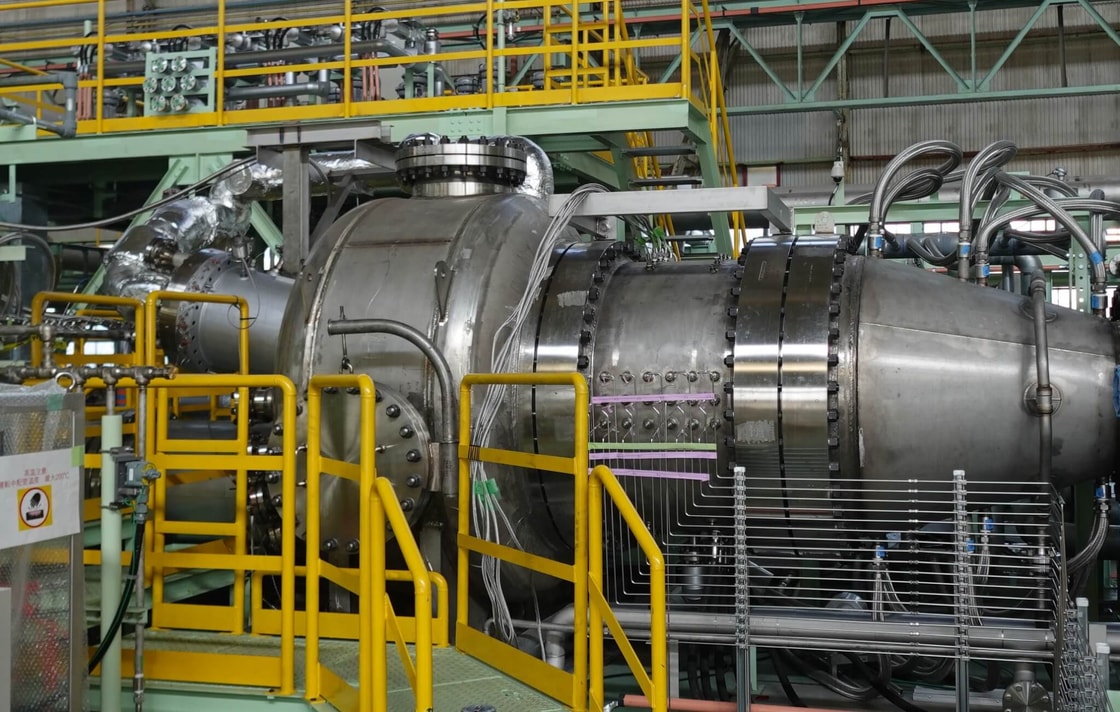
The test conducted at IHI’s purpose-built test facility builds on the pair’s 2024 joint development agreement and is aimed at commercialising the ammonia-fuelled engine by 2030.
The facility was engineered to replicate GEV’s F-class gas turbine operating conditions.
The Massachusetts-based energy technology company said its 9F gas turbine – the largest of the F-class range with which the engine is expected to be compatible – has a net output of 294MW.
Noriaki Ozawa, IHI’s Managing Executive Officer, said the successful combustion represents significant development in a critical part of the ammonia value chain.
“We see significant potential for ammonia as a carbon‑free combustion fuel and are energised to continue working together to help unlock its role in advancing global decarbonization.” Added Jeremee Wetherby, GE Vernova’s Carbon Solutions leader.
Japan and other Asian countries are looking to clean hydrogen-based ammonia as a solution to decarbonise their power generation base.
While use of the compound could accelerate demand for clean hydrogen, combusting ammonia is not emissions-free.
No carbon dioxide is emitted in the process. However, it does emit potent greenhouse gases like nitrogen oxides, as well as contributing to fine particulate matter.
As the UK ends coal, Asia embraces ammonia co-firing
In September 2024, the UK became the first major nation to end its use of coal in electricity generation, concluding its more than 140-year reliance on the fossil fuel. The closure of the Ratcliffe-on-Soar plant on September 30 reflects the UK’s aim for all electricity to be generated from clean sources by 2035.
In contrast to the UK’s outright elimination of coal, countries in Asia face a different challenge. With a more substantial reliance on coal and less immediate access to natural gas and renewable infrastructure, nations like Japan and South Korea are looking at transitional solutions like ammonia co-firing to reduce emissions while maintaining energy security.
In 2022, Wärtsilä Energy’s Rethinking Energy in Southeast Asia report said that green hydrogen-based fuels could be key for seasonal power balancing in Southeast Asia1.
It said, “The coal power plants and large combined cycle gas turbines (CCGTs) that currently dominate power systems in Southeast Asia cannot adapt to the intermittent nature of renewables, forcing some countries to curtail massive amounts of renewable energy. For renewable energy to become the main source of energy, grids need to be equipped to balance, store and optimise renewable energy…
Click here to keep reading.