

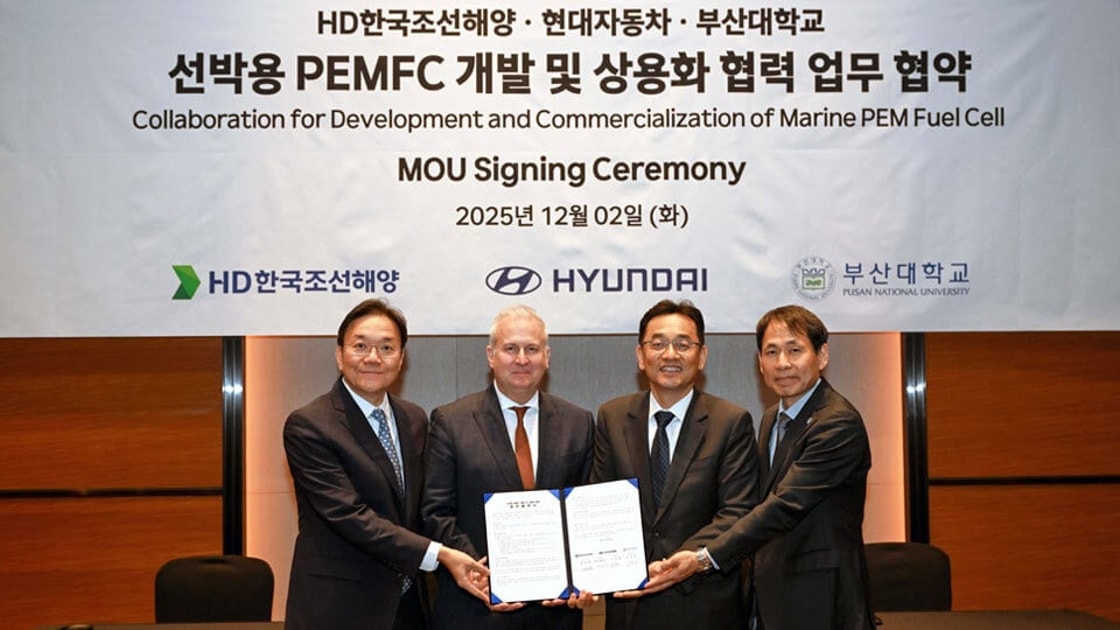
Under a memorandum of understanding (MOU), the trio will use Hyundai’s PEM fuel cells – typically used in its road vehicles – as a base for the systems.
Shipbuilder HD KSOE intends to integrate the fuel cell technology with hydrogen dual-fuel engines to deliver a hybrid electrified propulsion system for mid- to large-scale liquefied hydrogen carriers.
PNU will look to evaluate and demonstrate the system.
Hyundai Executive Vice-President, Ken Ramírez, said the group aims to “set a new standard for future marine mobility.”
HD KSOE has been developing designs for liquid hydrogen carriers that could run on hybrid electric and hydrogen dual-fuel propulsion systems. In 2024, the firm secured an approval in principle (AIP) from DNV for its 80,000m3 design.
For Hyundai, it marks a diversification from its heavy focus on hydrogen for road mobility applications. The South Korean auto major has long pursued making fuel cell cars a key part of the zero-emission mobility mix.
However, the technology has faced major barriers with infrastructure development beyond a few regions, while electric passenger vehicles have made strides in deployments.
In October, the firm broke ground on a new fuel cell and electrolyser production facility in South Korea, which could be online by 2027.
This new partnership looks to capitalise on Hyundai’s technology development as the shipping sector looks to decarbonise.
“The goal of this collaboration is to develop propulsion systems for the future shipping market that align with the carbon reduction targets set by the IMO,” a statement said.
Stay ahead with a H2 View subscription
Gain access to the insights, data, and analysis trusted by hydrogen professionals worldwide.
With a H2 View subscription, you get:
- Unlimited access to 15,000+ articles
- Monthly digital magazine + H2 Review
- Exclusive interviews, webinars and reports
- Expert analysis shaping the hydrogen conversation