
While LNG produces less CO2 and NOx emissions than conventional fuels, it still contributes to greenhouse gases. Hycamite’s Thermo-Catalytic Decomposition (TCD) technology splits the methane in LNG into hydrogen and solid carbon, such as graphite.
The generated hydrogen can be used to power dual-fuel engines or fuel cells cleanly, while the solid carbon is stored onboard instead of being released as CO2.
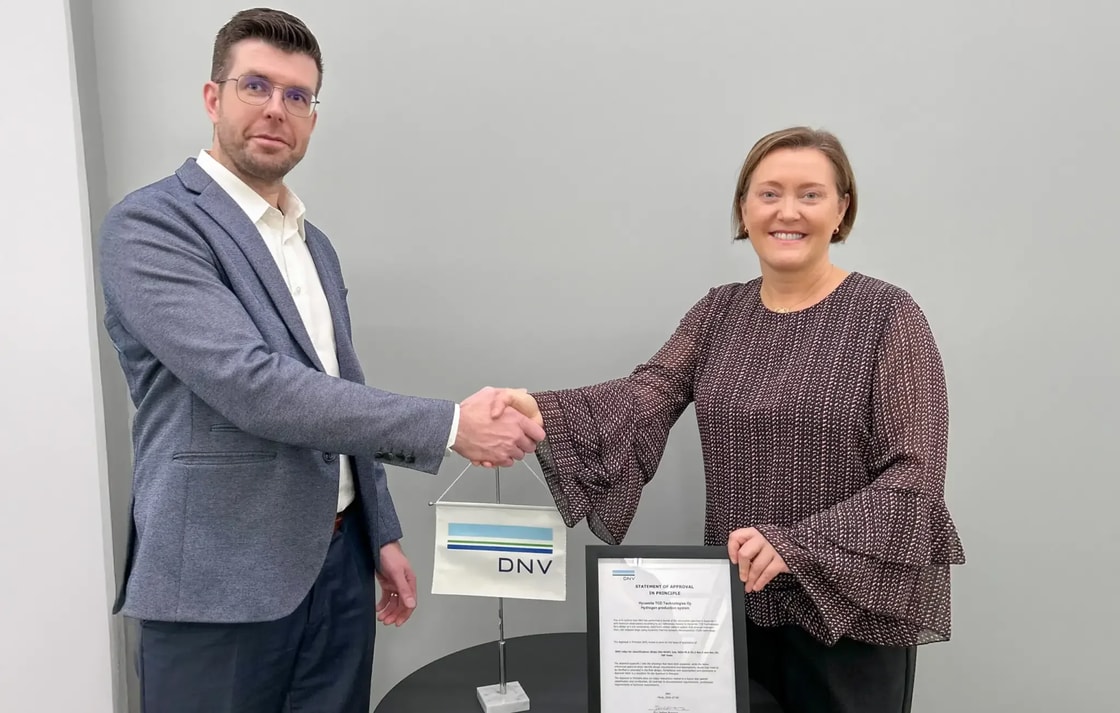
DNV awarded the Finnish technology firm an Approval in Principle (AiP) for its concept design of the pre-combustion, solid-form carbon capture system.
The award “confirms the feasibility of the design and ensures there are no significant technical obstacles hindering its implementation,” according to Hycamite’s press statement.
It represents the first time a pre-combustion carbon capture technology, designed for onboard hydrogen production, has been recognised for an AiP, according to DNV’s Torill Grimstad Osberg.
“Because as the maritime industry works towards Net Zero, finding new fuel solutions that are efficient, scalable and green is vital,” Osberg said. “We look forward to building on this cooperation and are ready to put our expertise towards helping to realise the benefits of this innovative technology safely.”
Laura Rahikka, Hycamite’s CEO, added that Hycamite’s solution offers “a practical alternative to liquefied hydrogen,” which remains unlikely to see widespread use in maritime due to its handling complexity, storage challenges, and low energy density.
Stay ahead with a H2 View subscription
Gain access to the insights, data, and analysis trusted by hydrogen professionals worldwide.
With a H2 View subscription, you get:
- Unlimited access to 15,000+ articles
- Monthly digital magazine + H2 Review
- Exclusive interviews, webinars and reports
- Expert analysis shaping the hydrogen conversation