

Additionally, ABB supplied the superyacht’s main propulsion system, power and energy management system, and marine pilot control, among other key technologies, enabling reliable performance in real-world operations.
“This order represents a breakthrough in the integration of marine fuel cells with propulsion systems,” ABB’s Riccardo Repetto said, “[and] Feadship’s breakthrough showcases the potential of hydrogen fuel cells as a feasible alternative to conventional energy sources in shipping.”
The 118-metre yacht was launched in May 2024 under the name Project821. The vessel was delivered to its owner in May 2025 and is scheduled to feature at the Monaco Yacht Show in September 2025.
However, reports stated last year that, despite its 100+ metre size, the vessel cannot carry enough liquid hydrogen to power a crossing but can instead generate enough electricity to serve the hotel load. Project 821’s double-walled cryogenic fuel tank holds four tonnes of hydrogen.
Therefore, during longer travels or when pure hydrogen is not available, electricity powering a 3,200kW ABB pod drive comes from MTU generators combusting HVO.
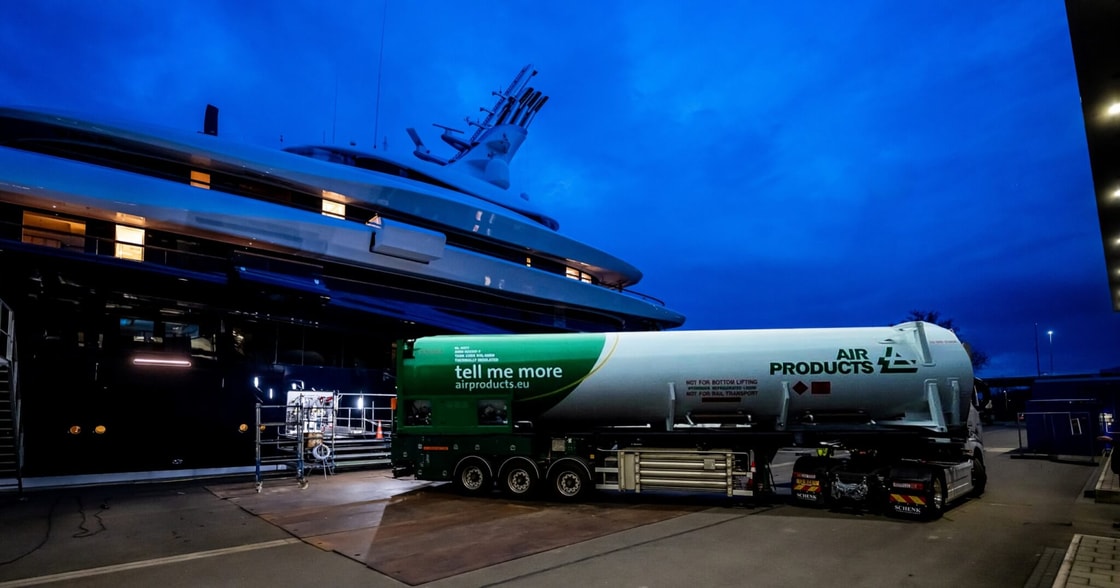
Earlier this year, oil and gas major Air Products supplied liquid hydrogen to the vessel at the Royal Van Lent shipyard in the Netherlands.
The event demonstrated that liquid hydrogen can be safely and efficiently integrated into marine infrastructure.
But while hydrogen is emerging as a viable option for short-range marine applications, derived fuels such as e-methanol or ammonia may prove more successful in the long term due to their higher energy density, simpler storage requirements, and greater compatibility with existing fuel infrastructure.