

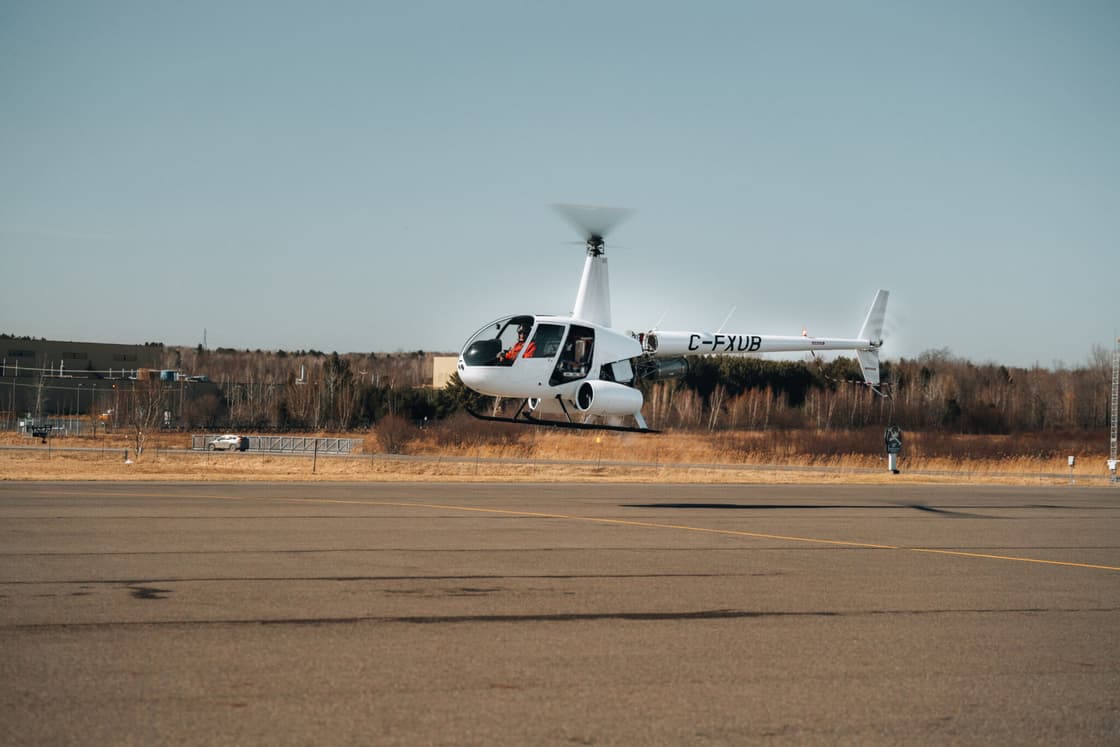
The company claimed that the project, which was showcased for the Canadian Advanced Air Mobility (CAAM), was a world first for hydrogen-powered helicopter operations. The demonstration occurred at Roland-Désourdy Airport in Bromont, Québec, on March 27, 2025.
Test pilot Ric Webb flew the Robinson R44 Raven II, equipped with a dual PEM fuel cell and battery hybrid powertrain, under an experimental flight permit from Transport Canada Civil Aviation (TCAA).
According to Unither, the three-minute, 16-second flight validated the capabilities of a hydrogen fuel cell in this use case. Approximately 90% of the flight’s energy came from the hydrogen fuel cells.
Mikaël Cardinal, Vice President of Programme Management & Business Development, Organ Delivery Systems for Unither Bioelectronics, said the company will now enter the next phase of Project Proticity with partner Robinson Helicopter Company.
“Our next phase of development will focus on integrating a liquid hydrogen storage system, which we believe is an essential technology for enabling our extended-range missions to deliver manufactured organ alternatives to patients in need,” he explained.
Hydrogen for aviation: High in the sky or pie in the sky?
Aviation carbon dioxide (CO2) emissions are one billion tonnes per year – similar to the total annual CO2 emissions from Germany or Canada. And aviation CO2 emissions are rising faster than other transport sectors.
Green hydrogen can be produced from renewable electrical power. Blue, low-carbon hydrogen is produced from fossil fuels with permanent storage of the CO2 emissions.
Sustainable aviation is in its infancy. The breadth of solutions is broad. The winning solutions may be known to us today or could yet emerge. However, the benefits of pursuing defossilisation in this sector will be felt in our lifetime and will leave a legacy that we can be proud of for generations to come.
Continue reading here.