

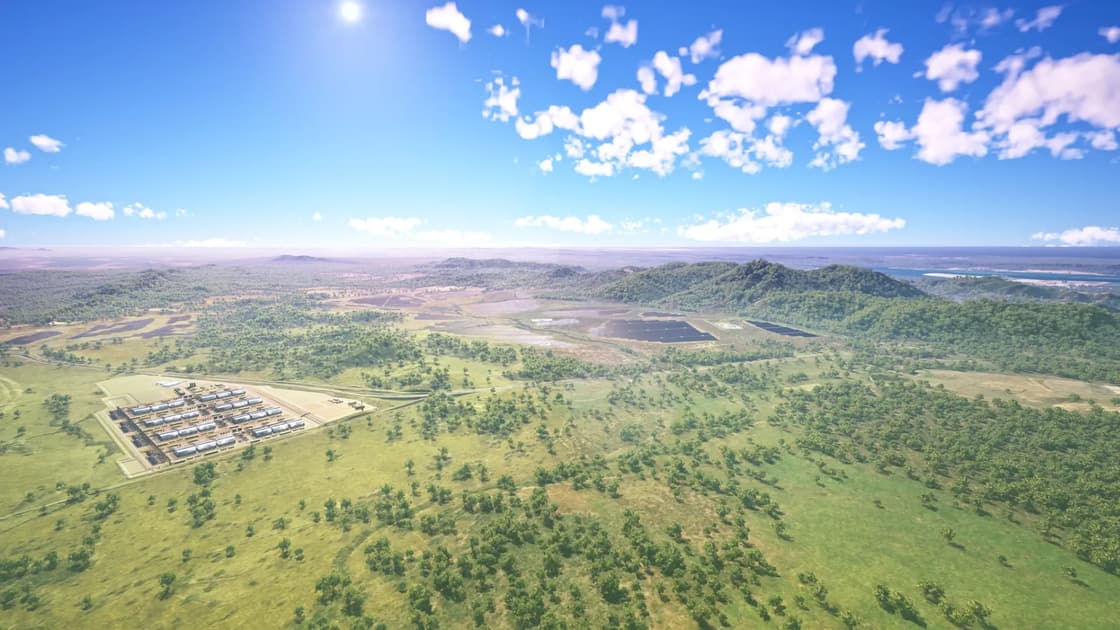
Asian media outlet Nikkei first reported the news, indicating that Iwatani withdrew from the project amid mounting global challenges to decarbonisation. The Japanese multinational has also shut down its Queensland office, according to Nikkei.
Just last month, the Queensland Government rejected project developer Stanwell Corporation’s AUD $1bn ($614m) funding request through the Australian Renewable Energy Agency (ARENA). Adding to the project’s setbacks, CQ-H2 lost another Japanese consortium partner last November when Kansai Electric withdrew.
Under a 2020 Memorandum of Understanding (MoU) with Stanwell, Iwatani planned to develop a large-scale liquefied renewable hydrogen supply chain between Central Queensland and Japan.
The company played a key role in project development, joining feasibility studies on electrolysis, storage, liquefaction, transport, and shipping.
Iwatani also helped form the project consortium with Marubeni Corporation and Keppel Infrastructure and contributed to securing funding for the AUD $117m ($74m) front-end engineering and design (FEED) phase, backed by ARENA and the Queensland Government.
CQ-H2 aims to start with a 720MW electrolyser, producing an average of 200 tonnes of hydrogen per day. At full scale, the project plans to expand to 2.88GW, ramping up production to 2,880 tonnes per day.
A final investment decision (FID) on the first phase was expected this year, with initial commercial operations slated for 2029 and full-scale production by 2031.
However, after the Queensland Government withdrew support for the AUD 12.5bn ($7.68bn) CQ-H2 project, Stanwell announced on February 3, 2025, that it is “reviewing its involvement in this and other hydrogen initiatives and will work with relevant stakeholders regarding future steps for these projects.”
Speaking to Sky News Australia last month, Nationals MP Colin Boyce called the government’s decision to pull funding a “common sense decision,” adding that the plans for renewable capacity up and down the nation’s east coast are “economic insanity.”
H2 View contacted Stanwell Corporation for confirmation on Iwatani’s exit, but had not received a response by the time of publication.
Analysis: Billions pledged, projects paused – what’s next for Australia’s hydrogen industry?
Australia’s hydrogen sector has encountered significant challenges over the past year, highlighted by the South Australian Government’s recent decision to reallocate funding from the Whyalla hydrogen project to support local steelworks.
It came as the fourth project, with federal or state support, to be in the spotlight for apparent failures, opening the Labor government to stark, anti-hydrogen political opposition – just months away from a federal election.
bp’s 105MW Kwinana project, Origin Energy’s Hunter Valley Hydrogen Hub and Stanwell Corporation’s Central Queensland Hydrogen Project (CQ-H2) were all selected for a share of AUD $2bn Hydrogen Headstart Program.
The funding scheme planned to provide the prospective hydrogen producers with a 10-year production credit, aimed at closing the gap between high production costs and sale prices.
But all four projects have faced setbacks, often entangled in political rhetoric. This has only been catalysed with backtracks on green hydrogen targets from the likes of Fortescuee.
Continue reading here.